Saturday, April 14, 2007

Issue Ads in Bedford Gazette

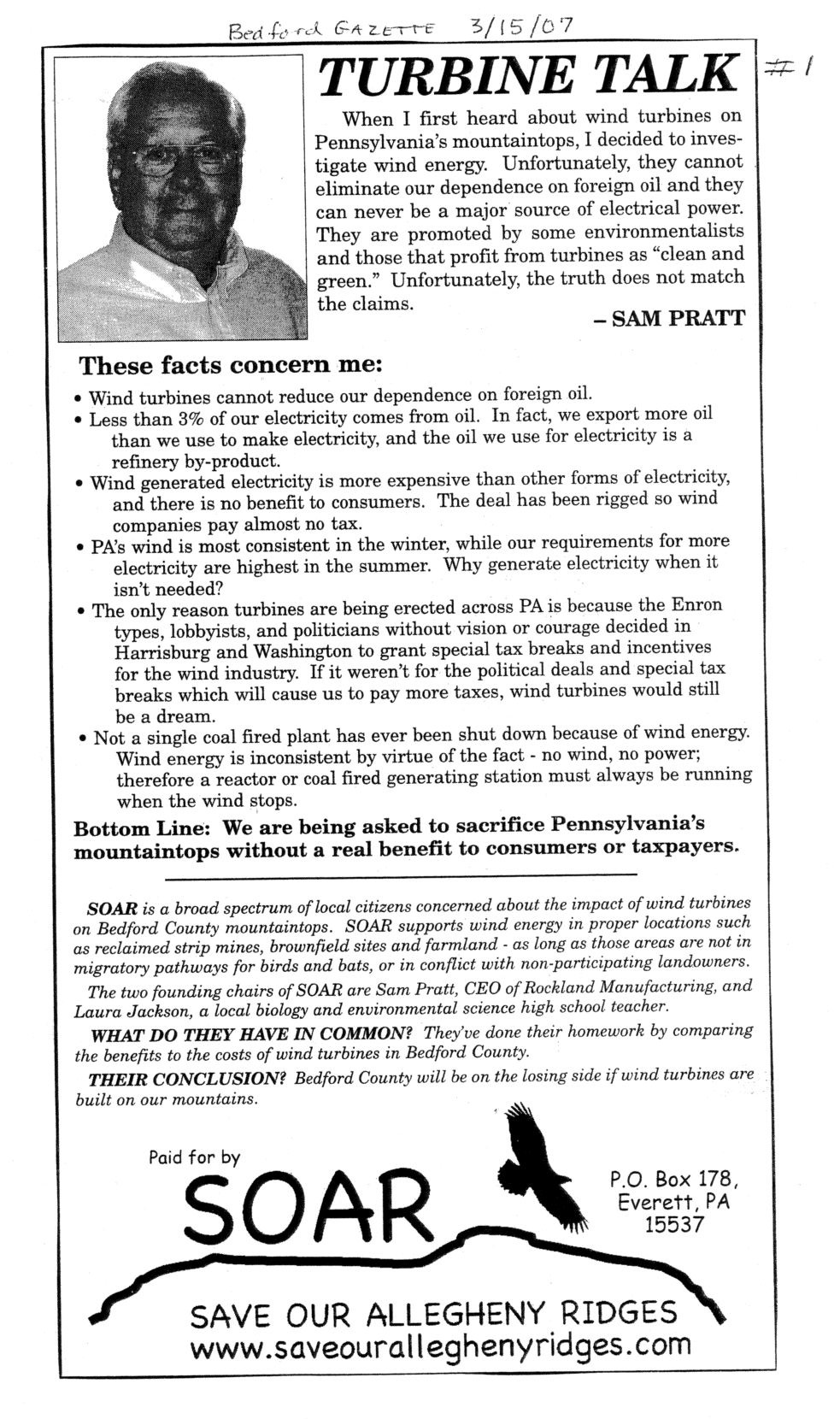
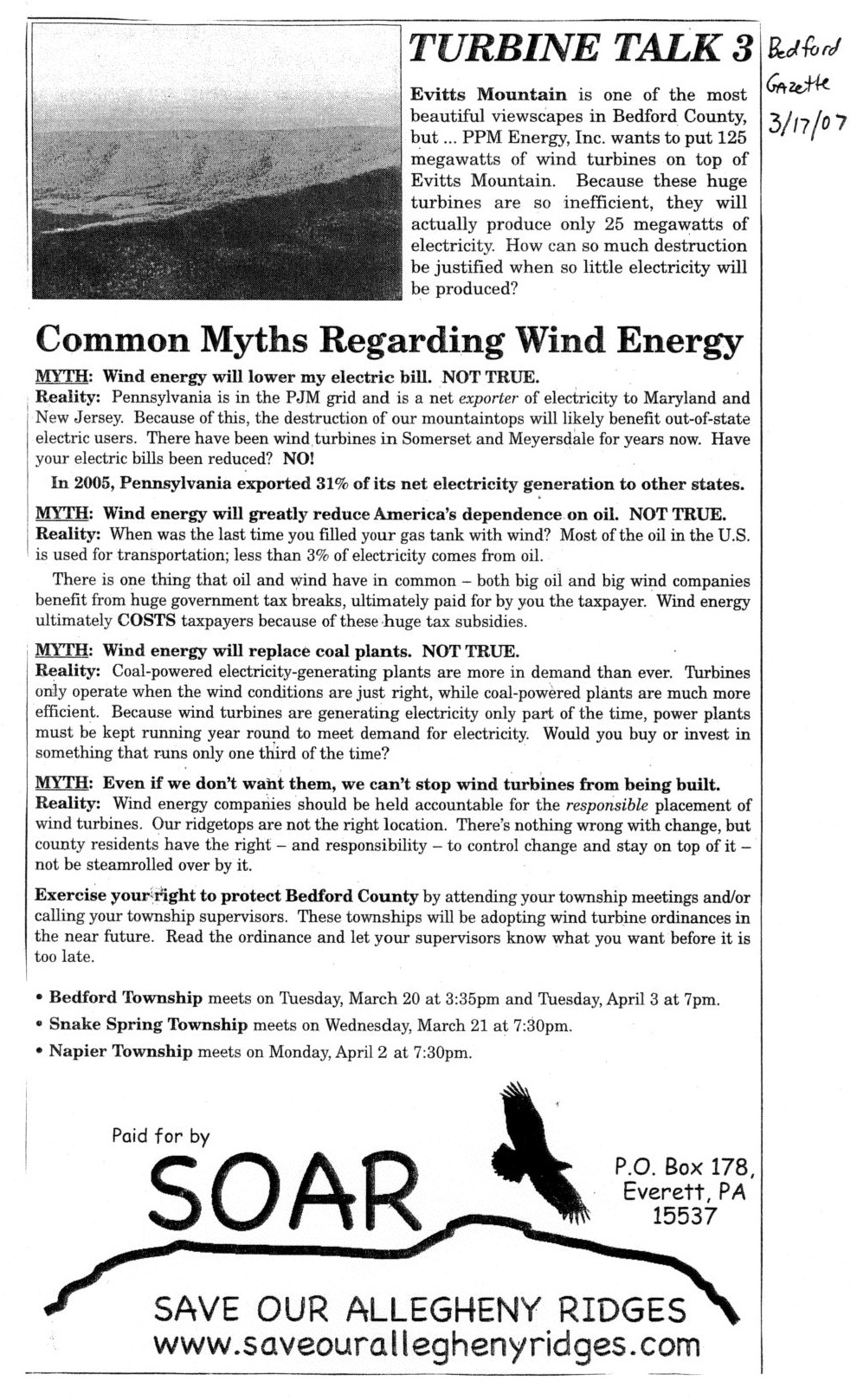
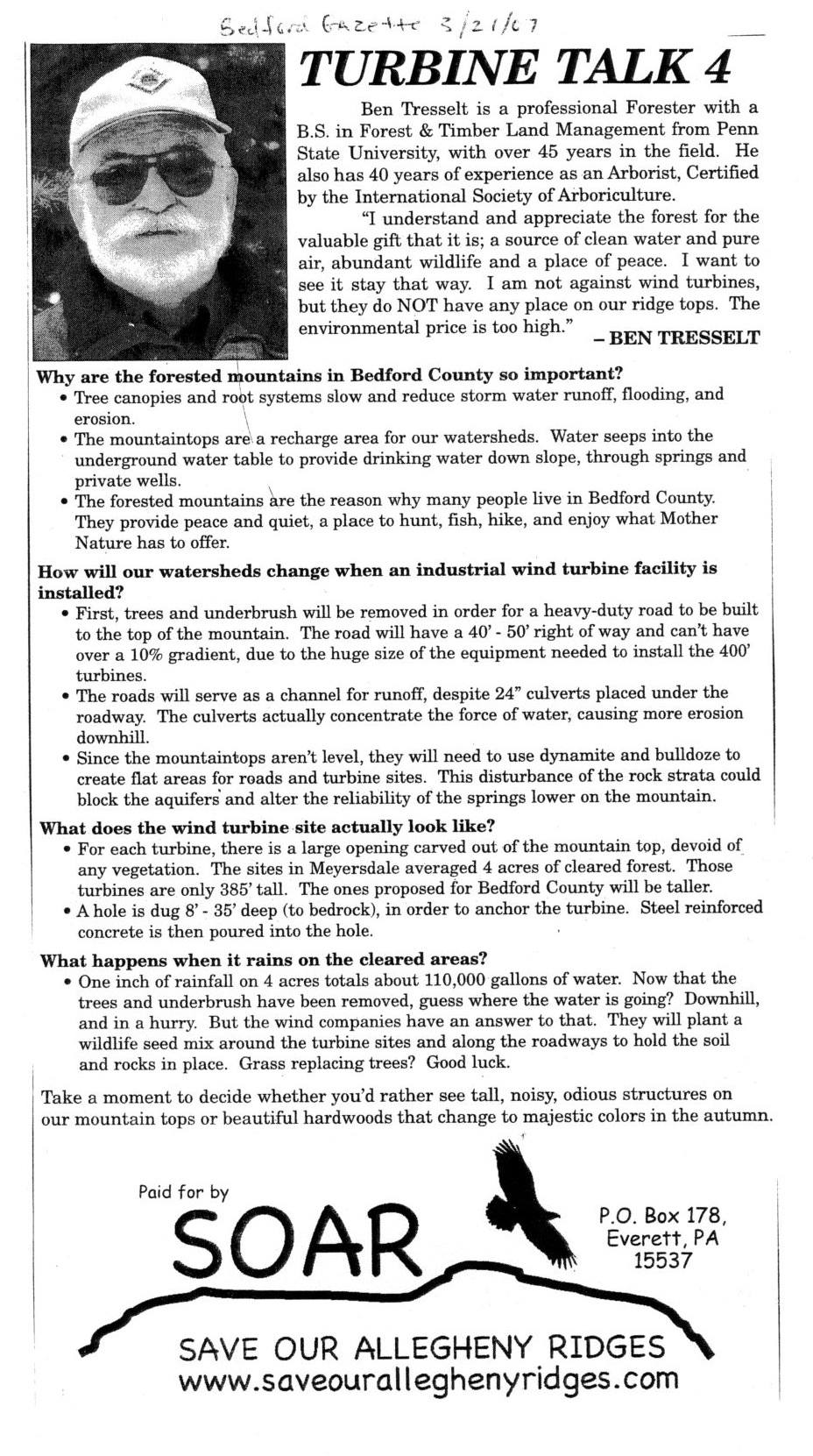
Turbine Talk

Message from Sam Pratt

Sam Pratt, CEO of Rockland Manufacturing, headquartered in Bedford, PA, says:

When I first heard about wind turbines on Pennsylvania's mountaintops, I decided to inves­tigate wind energy. Unfortunately, they cannot eliminate our dependence on foreign oil and they can never be a major source of electrical power. They are promoted by some environmentalists and those that profit from turbines as "clean and green." Unfortunately, the truth does not match the claims.

These facts concern me.

Sunday, April 08, 2007

GE Admits 90% Inefficiency

General Electric, manufacturer of wind turbines, admits to the New York State Energy Research & Development Authority (NYSERDA) that its turbines' effective capacity factor is only 10% in New York State inland sites

HT: Nina Pierpont

Monday, April 02, 2007

Noise Complaints on Rise

Noise Complaints On Rise with New Industrial Wind Power Projects

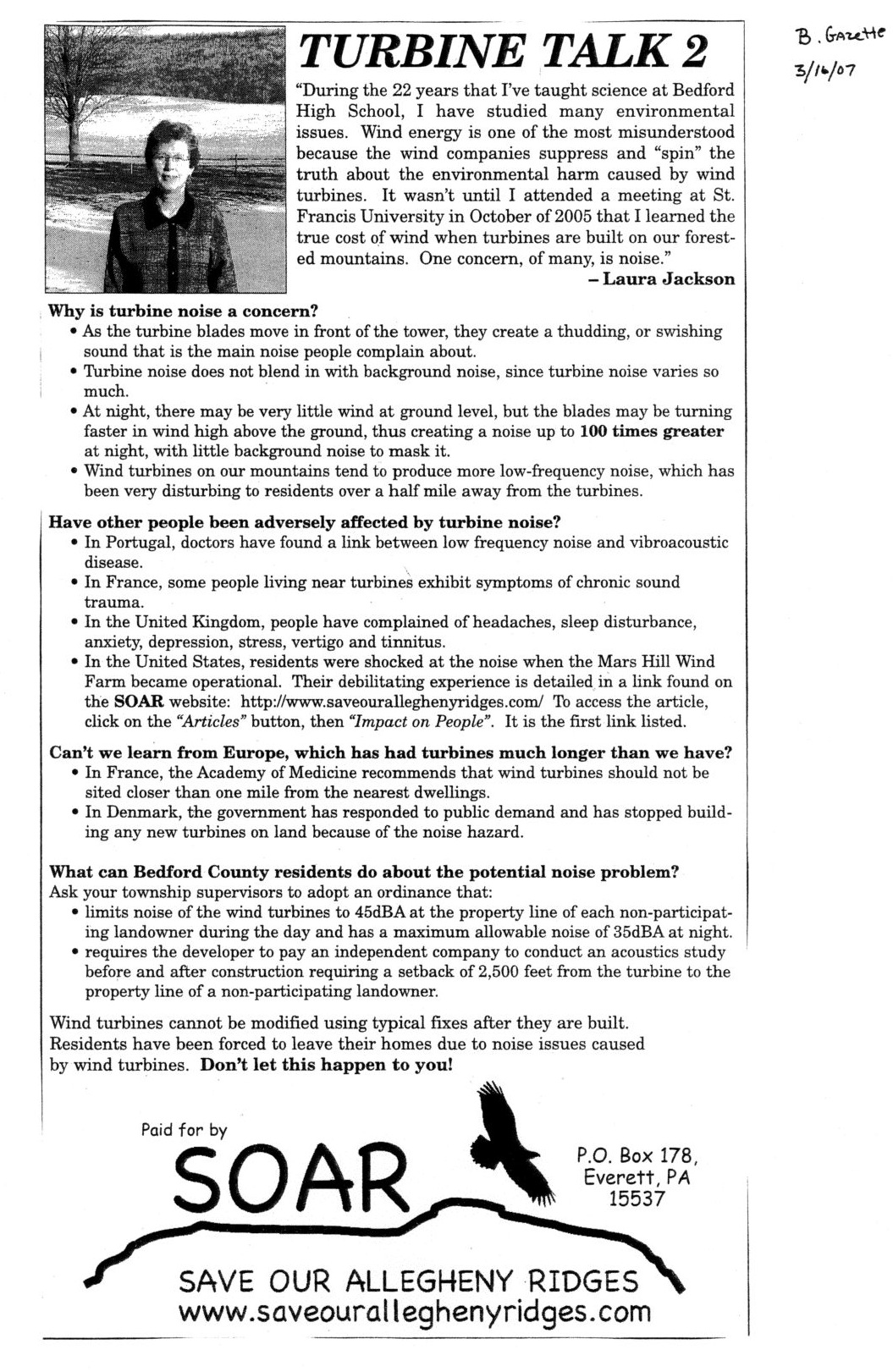
Noise created by commercial-scale wind turbines has become a major concern around the world as wind power development continues to proliferate. Although the industry claims that modern turbines are quieter — even as they grow ever larger — complaints are increasing from people who live near new projects.

While the wind itself may mask some of the noise under some atmospheric conditions, the deep unnatural thumping as the giant blades pass their supporting tower is particularly intrusive. Testimony from hundreds of turbine neighbors confirms this, most recently from Maine, Massachusetts, New York, Pennsylvania, Illinois, Wisconsin, Texas, Canada, the U.K., and New Zealand. Reports can be found at www.wind-watch.org/news and www.wind-watch.org/documents.

The noise is especially intrusive because wind energy facilities are often built in rural areas where the ambient sound level may be quite low, especially at night. On the logarithmic decibel (dB) scale, an increase of 10 dB is perceived as a doubling of the noise level. An increase of 6 dB is considered to be a serious community issue. Since a quiet night in the country is typically around 25 dB, the common claim by wind developers of 45 dB at the nearest home would be perceived as a noise four times louder than normal. And because it is intermittent and directional, those affected assert that one can never get used to it. The disruption of sleep alone presents serious health and human rights issues.

The problem is worse than the industry admits. Frits van den Berg, a physicist at the University of Groningen in The Netherlands, studied noise levels around a German facility of 17 turbines. In a 2003 paper published in the Journal of Sound and Vibration, he found that at night, because the surface air is often more still than the air at the height of the blades, the noise from the turbines is 15 to 18 dB higher than during the day and carries farther. He noted that residents 1.9 kilometers (6,200 feet or 1.2 miles) away expressed strong annoyance with noise from the facility.

The French National Academy of Medicine has called for a halt of all large-scale wind development within 1.5 kilometers of any residence, because the sounds emitted by the blades constitute a permanent risk for people exposed to them. The U.K. Noise Association studied the issue and agreed with the recommendation of a 1-mile setback.

Full article here.

Sunday, April 01, 2007

Recoup your losses.

Windmills devalue your property and home? Recoup your losses by investing in a wind company.

Earlier this week, Goldman Sachs more than doubled its money by selling Horizon Wind Energy, a developer and operator of wind power generation, for at least $2.15 billion to Energias de Portugal….

German wind turbine manufacturer REpower Systems has also seen its market valuation more than triple in the last year, to 150 euros ($200) a share, and in recent weeks has received takeover bids of around $1.7 billion from French nuclear power company Areva and India's Suzlon Energy.

Full article here
.

Sunday, March 25, 2007

Blades Peeling Apart "Piece by Piece"

Lightning and cold weather may be culprits at nearby Allegheny Ridge Wind Project.

Trade association: ‘Blade problems are rare’

Wind-energy experts say incidents such as the splintering of two blades and cracks in five others produced at Gamesa’s Cambria Township factory are rare.
The American Wind Energy Association views the problem as a fluke, an anomaly that turned up in a time-proven industry involving a highly respected company.
“We haven’t heard of anything like this before. There have been thousands of blades installed, and this is a first,” said Christine Real-de-Azua, spokeswoman for the wind energy national trade association, based in Washington, D.C.
“Offhand, this doesn’t seem like a big issue. We haven’t heard of any other problems.”
Gamesa officials as late as Friday continued to search for a cause of the Fiberglas skin cracking on the blades, which were installed during the past several months on turbines at Allegheny Ridge Wind Farm in Portage and Washington townships.
With the troublesome blades now being removed from the towers and two already back at the Ebensburg-area plant, Gamesa officials said they will continue the investigation until the mystery is solved.
“We’re still analyzing all of the information recorded,” plant manager Alberto Gros said Friday. “We’re going back to the original material we used, the transportation.”
The problem will have no impact on employment levels at the Ebensburg-area plant, Gros said.
Investigators, including two from Spain, are looking at the manufacturing process, shipping and installation of the 143-foot-long blades on the towers, he said. Attention will be paid to all aspects of the weather, including two extreme cold spells when some of the blades were installed.
“Lightning can be a problem,” Gros told officials from Portage and Washington townships last week. “We’re trying to get as much information as we can.”
The defect is showing as cracks on the Fiberglas membrane stretched over the harder Fiberglas and plastic blade form.
“We know they are not well bonded on the edge,” Gros said.
“We’re looking at that area.”
In addition, a team of experts is at the wind farm going over blades still on the towers.
The plant has turned out 360 blades so far, a number of which were shipped to wind farms in Texas and Illinois. Gros said skin cracking has not occurred in those areas.
Five defective blades at the Portage and Washington township farm were spotted by Gamesa workers after they were in place on the towers, while the side of a sixth splintered and fell to the ground. A larger outside percentage of the skin on a seventh blade came off and also fell, officials said.
“Piece by piece, they just peel apart,” said Gros, who has been with the company for 10 years.

Full Story: Johnstown Tribune-Democrat, March 24, 2007
HT: National Wind Watch

Thursday, March 15, 2007

Local Authorities Oppose Gamesa Plan

Water authority votes against wind farm

Windber Area Authority members voted to oppose a wind turbine project slated for the Shaffer Mountain area over concerns that the watershed will be negatively impacted.....
Chairman William Oldham said that as more information is publicly released, the more concerned he is with the project, which is slated to bring 30 turbines to the mountain.
The site's extensive road system and other details like the potential for a concrete batching plant worry him.“I think that we haven't been told enough.
I'm against them,” he said.The board subsequently voted 5-1 against the project as a whole.
That makes the authority the fourth governing body to make a resolution publicly opposing the watershed project in recent months.
Paint Township supervisors, Paint Borough council and Windber Borough council members have all voted against the project since February.
Where that leaves the project is still to be determined said Project Developer Tim Vought, who represented the company at the authority meeting....

Complete story »

Suit to be Filed to Stop Shaffer Mountain Windplant

Residents work to stop windmills

NEW PARIS - Residents determined to stop the Shaffer Mountain Wind Farm have issued a notice of intent to file suit with federal and state agencies over environmental concerns.The notices were mailed March 2 by environmental attorney Bradley Tupi who is with Tucker/Arensburg Attorneys, Pittsburgh, and is representing several families within the project area.“We’re still […]
Complete story »

Thursday, March 01, 2007

Health Effects of Wind Turbine Noise

Two British researchers, Barbara J. Frey and Peter J. Hadden, recently published a 137-page report on "Noise radiation from wind turbines installed near homes: Effects on health, with an annotated review of the research and related issues" (February 2007). See www.windturbinenoisehealthhumanrights.com. It's likely the best single source to date within the emerging body of documentation on health issues effected by industrial wind turbines. The report includes, by the way, a lengthy annecdotal compilation regarding property devaluations that occur when wind turbines are sited too close to dwellings and residential lands.

After voluminous documentation, the authors recommend a minimum setback of 2km (1.25 miles) from people's homes for turbines up to 2MW installed capacity, and larger setbacks for any turbines over 2MW.

Following is the report's abstract:
Wind turbines are large industrial structures that create obtrusive environmental noise pollution when built too close to dwellings. This annotated review of evidence and research by experts considers the impact of industrial-scale wind turbines suffered by those living nearby. First, the paper includes the comments by some of the families affected by wind turbines, as well as coverage in news media internationally. The experiences described put a human face to the science of acoustics.

Second, the paper reviews research articles within the field of acoustics concerning the acoustic properties of wind turbines and noise. The acoustic characteristics of wind turbines are complex and in combination produce acoustic radiation. Next, the paper reviews the health effects that may result from the acoustic radiation caused by wind turbines, as well as the health effects from noise, because the symptoms parallel one another. Primarily, the consequent health response includes sleep deprivation and the problems that ensue as a result. In addition, this paper reviews articles that report research about the body's response not only to the audible noise, but also to the inaudible components of noise that can adversely affect the body's physiology. Research points to a causal link between unwanted sound and sleep deprivation and stress, i.e., whole body physiologic responses.

These injuries are considered in the context of Human Rights, where it is contended that the environmental noise pollution destroys a person's effective enjoyment of right to respect for home and private life, a violation of Article 8 of the European Court of Human Rights Act. Furthermore, the paper considers the consequent devaluation of a dwelling as a measure of part of the damage that arises when wind turbines are sited too close to a dwelling, causing acoustic radiation and consequent adverse health responses.

The review concludes that a safe buffer zone of at least 2km should exist between family dwellings and industrial wind turbines of up to 2MW installed capacity, with greater separation for a wind turbine greater than 2MW installed capacity

Hat Tip:
Save Western New York
.

Saturday, February 17, 2007

The Direct Approach

Board adopts tall structures ordinance

The Enterprise, February 17, 2007, Stuart, VA.

"The issue that roared into Patrick County like a windstorm almost a year ago blew away Monday like a gentle breeze.

"The Patrick County Board of Supervisors voted to pass a tall structures ordinance that will prohibit the construction of 400-foot wind turbines on the county’s mountain ridges. Telecommunications towers and church steeples are exempt from the tall structures ban."

Full story.

Sunday, February 11, 2007

Writer's Tool Kit

Thinking of writing, but don't have the time? Try using these tools:

1.Talking Points - Wind Salesmen’s Talking Points and the Facts that Refute Them

A point-by-point refutation of common claims made about the effect of windplants on reducing CO2 emissions, oil consumption, foreign oil dependence, fossil fuel consumption, global warming, electricity generation costs, electricity user costs, future energy shortages, local tax base, local employment, local businesses and tourism economy, health and safety of neighbors, and forests, watersheds and ecosystems.

This has been prepared for use, freely and without obligatory attribution of any kind, in writing media and elected officials. It’s in Word file format, so that users can copy/paste as expedient.

2 Address Books – Also in Word file format, for easy copy/paste to letters and envelopes. Email addresses and phone numbers included where available.

Politicians: Directory of state, county and township officials

Media: Directory of regional and local media

SOAR: Address Book for Bedford County Members

.

Wednesday, February 07, 2007

Allegheny Township News

Windmill ordinance to be advertised
Somerset Daily American, Jennifer Garlesky, February 6, 2007

ALLEGHENY TOWNSHIP - At Monday night’s meeting, supervisors voted to advertise the township’s ordinance regulating the placement of wind turbines.
...

The township ordinance requires a setback of five times the turbine height between the windmill and the home or business of a non-participating property owner. A non-participating property owner is someone who has not given the developer permission to build a tower within the setback distance.

The township setback requirements are more stringent than the county’s wind energy ordinance because of the measurements used to establish the figure. The county ordinance states the turbine must have a setback of five times the hub height, not the total height of the windmill. Full article.